


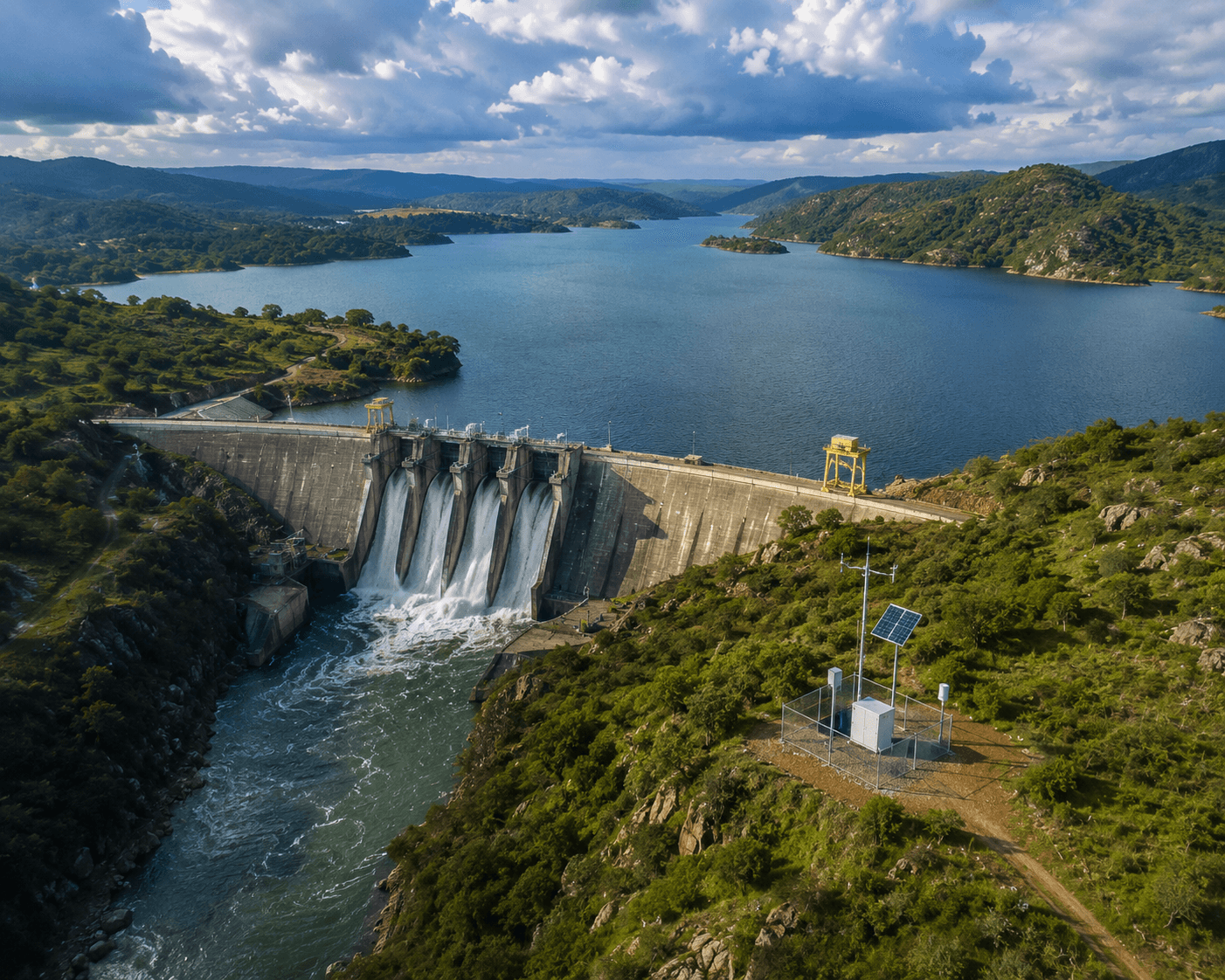
Dam failures rarely start as a dramatic event. They start as a seepage trend nobody was measuring closely enough to notice in time.
Dam safety monitoring has traditionally relied on scheduled inspection walks: an engineer visits, checks the wall visually, takes a manual reading, and moves on until the next scheduled visit. The problem is that the failure modes that actually matter, slow seepage through an earth wall, gradual settlement, a pressure trend building over weeks, rarely announce themselves between two inspection dates in a way a walking inspection will reliably catch before it matters.
Modern dam monitoring approaches combine geodetic sensors with geotechnical instruments, piezometers to measure internal seepage pressure, tilt sensors and inclinometers to detect movement, and continuous water-level gauges, feeding all of it into a single monitoring system rather than a clipboard. The shift is from periodic snapshots to continuous trend data, which is the only way to catch a slow-developing structural issue while it is still a maintenance problem rather than an emergency.
For water authorities managing ageing infrastructure, much of it decades old and originally instrumented with nothing more than a manual staff gauge, the case for upgrading is not hypothetical. A pressure trend that would take months to become visible on a fortnightly manual reading shows up within days on a continuous sensor feed, and a flash rainfall event that can raise a reservoir by metres in hours gives downstream communities meaningful warning time only if level data is flowing continuously, not once a day.
Kenya's own history makes the stakes concrete. On 9 May 2018, an earth dam on the Patel Coffee Estates in Solai, Nakuru County, gave way after days of heavy rain, releasing an estimated 190 million litres of water into the settlements below and killing at least 48 people, many of them children. The subsequent Senate investigation found the structure had been built from porous material without a proper spillway, and that underground faults combined with sustained water seepage had gone unaddressed until the wall simply failed. It was, in the investigation's own conclusion, not an act of God: it was a monitoring failure that had years, not hours, to be caught.
Solai was not an isolated gap in an otherwise well-instrumented system. A subsequent government audit found that of roughly 4,140 dams across Kenya, only 843 were formally regulated and inspected, leaving more than 3,200 structures with no one able to vouch for their current condition. Many of those are smaller, privately built, or agricultural dams, exactly the category least likely to have ever had a piezometer or a level sensor installed, and exactly the category where a slow seepage trend has the least chance of being caught by anyone before it becomes structural.
This is precisely the gap continuous sensor monitoring closes, and it is why the push since Solai, from the water regulator's renewed dam safety and classification requirements to insurers asking harder questions before underwriting reservoir-adjacent developments, has been toward instrumentation as a baseline expectation rather than an optional upgrade for flagship state-owned dams alone. A privately owned earth dam with a piezometer reporting seepage pressure daily and an automated threshold alert is a fundamentally different risk profile than the same structure checked by eye once a quarter, and that difference is measured in advance warning weeks, not minutes.
AdvaIoT deploys continuous water-level, seepage-pressure, and structural movement sensors on dam walls and reservoir infrastructure, feeding a live dashboard rather than a logbook, sized for everything from major water-authority reservoirs to privately operated agricultural and estate dams that have historically had no instrumentation at all. The goal is straightforward and, after Solai, no longer abstract: catch the trend while it is still a repair, not after it has become a headline.