


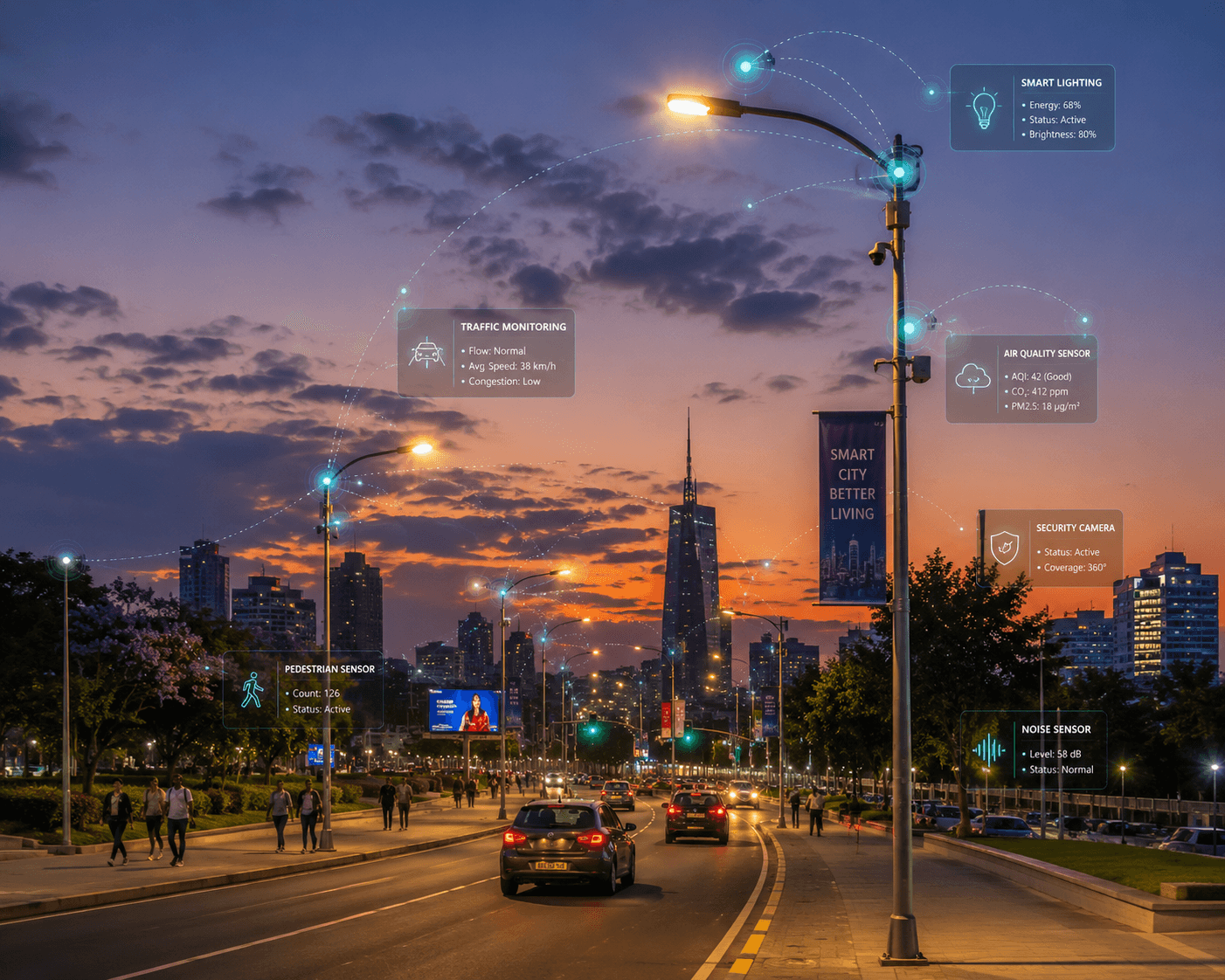
From Lagos's 10,000-light LED rollout to Nairobi's grid-constrained municipalities, street lighting is where smart city budgets are proving themselves first.
Smart city programs across Africa tend to start with ambitious, multi-year visions and then struggle to show results within a single budget cycle. Street lighting is the exception. It is one of the few municipal services where the cost baseline is already known, the failure mode is visible to every resident, and the payback on automation is measurable in a single fiscal year rather than a five-year masterplan.
The economics are straightforward. A single conventional streetlamp on a fixed nightly schedule can cost the equivalent of hundreds of dollars a year in grid electricity and reactive maintenance, much of it wasted illuminating empty roads at 2am at full brightness. Lagos State's initiative to deploy 10,000 LED streetlights, paired with a $7 million local LED manufacturing investment, reflects a broader pattern across West and East African cities: lighting retrofits are treated as an energy project first and a safety project second, because the energy savings fund everything else.
What separates a genuinely smart deployment from a simple LED swap is the monitoring layer. Adaptive dimming based on time and traffic, instant fault reporting instead of resident complaints as the primary detection method, and per-pole energy accounting all compound the savings a basic retrofit captures on its own. Cities that add this layer typically see total cost reductions well beyond the lighting bill alone, because maintenance crews stop patrolling routes blind and start responding to a live fault map.
Financing is often the real blocker for a county government, not the technology, and this is where a measurable, monitored energy reduction becomes more than an operations metric. Verified consumption data from a connected lighting network is exactly the kind of evidence climate and green-infrastructure financing programmes want to see before releasing funds, which turns the monitoring layer from a nice-to-have into the documentation that unlocks the next phase of the rollout.
AdvaIoT's smart city deployments have managed networks exceeding 8,000 connected streetlights for municipal clients, cutting energy costs by up to 42% while giving operations teams a live dashboard instead of a paper complaint log. For county governments operating under real budget constraints, that is the argument that gets a pilot approved: not a smart city vision, but a lighting bill that is measurably smaller within the first year.